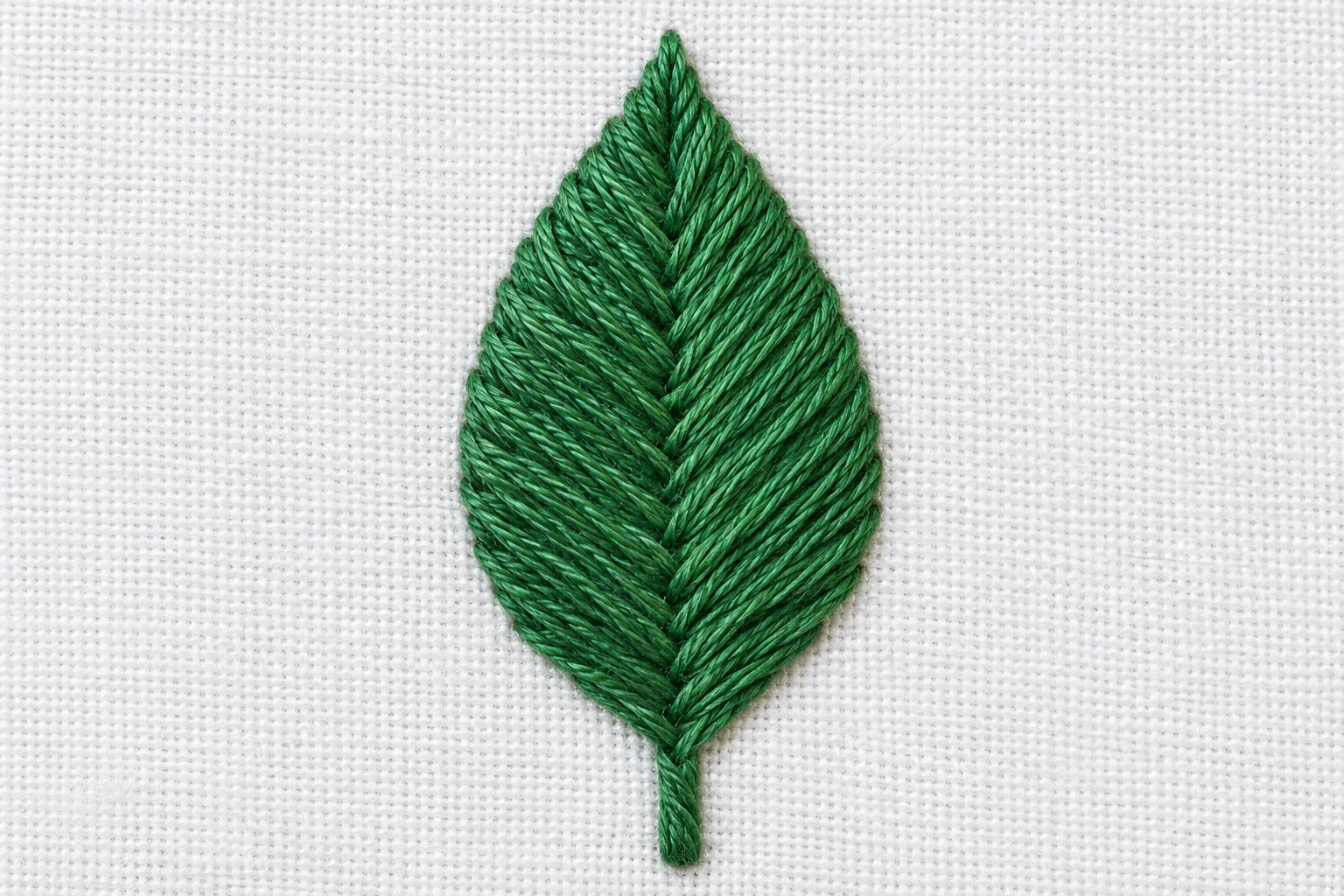
Fishbone stitch fills a pointed shape with alternating angled stitches that overlap around a center line. It is useful for leaves and stylized feathers because the middle suggests a vein. The direction changes on either side of that line, unlike a simple parallel satin stitch fill.
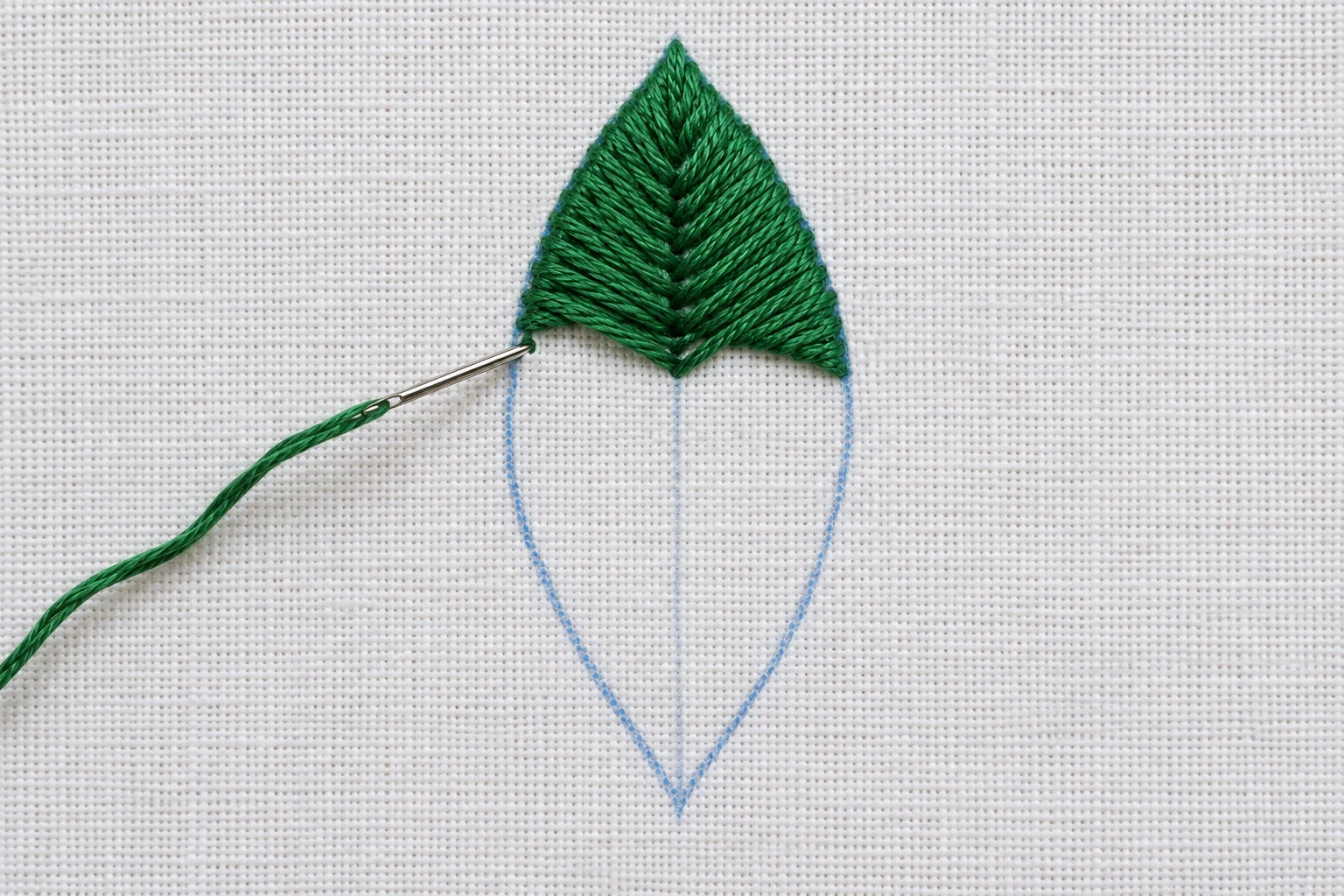
Mark the outline and center line, make a stitch from the tip toward the center and then alternate from the left and right edges. Let the stitch ends cross the center slightly so the fill forms a continuous central structure.
Mark a manageable leaf shape
Start with a small pointed oval on stable fabric. Draw a clear center line from tip to base. Two or three strands of cotton floss are a useful practice trial, provided the needle carries them comfortably.
Keep the first leaf narrow enough to fill without very long thread spans. An outline helps you place each outer entry point consistently.
Work alternate sides of the leaf
- Make a short starting stitch from the tip down along the center line.
- Come up on one edge just below the tip and go down slightly beyond the center line.
- Come up at a matching position on the opposite edge and cross back over the center.
- Continue alternating sides, moving gradually toward the base.
- Place the stitches closely enough to cover the fabric without repeatedly using one enlarged hole.
- Shorten the final stitches as the leaf narrows, then secure the thread.
Keep the slant regular. The central overlap should be controlled rather than a thick pile of thread.
Fix gaps and an uneven center
If gaps appear at the edge, place the next stitch closer to the previous one. If the center wanders, return to the marked line and check that both sides are advancing at a similar rate.
A bulky center can come from too many strands, overly long crossings or repeated stitches in the same position. Try a finer bundle on the next sample. Compare the result with satin stitch to see the difference between alternating directions and a parallel fill.
Frequently asked questions
Is fishbone stitch the same as satin stitch?
No. Fishbone alternates angled stitches across a center line. Satin stitch fills a shape with neighboring parallel stitches.
Can fishbone stitch fill a feather?
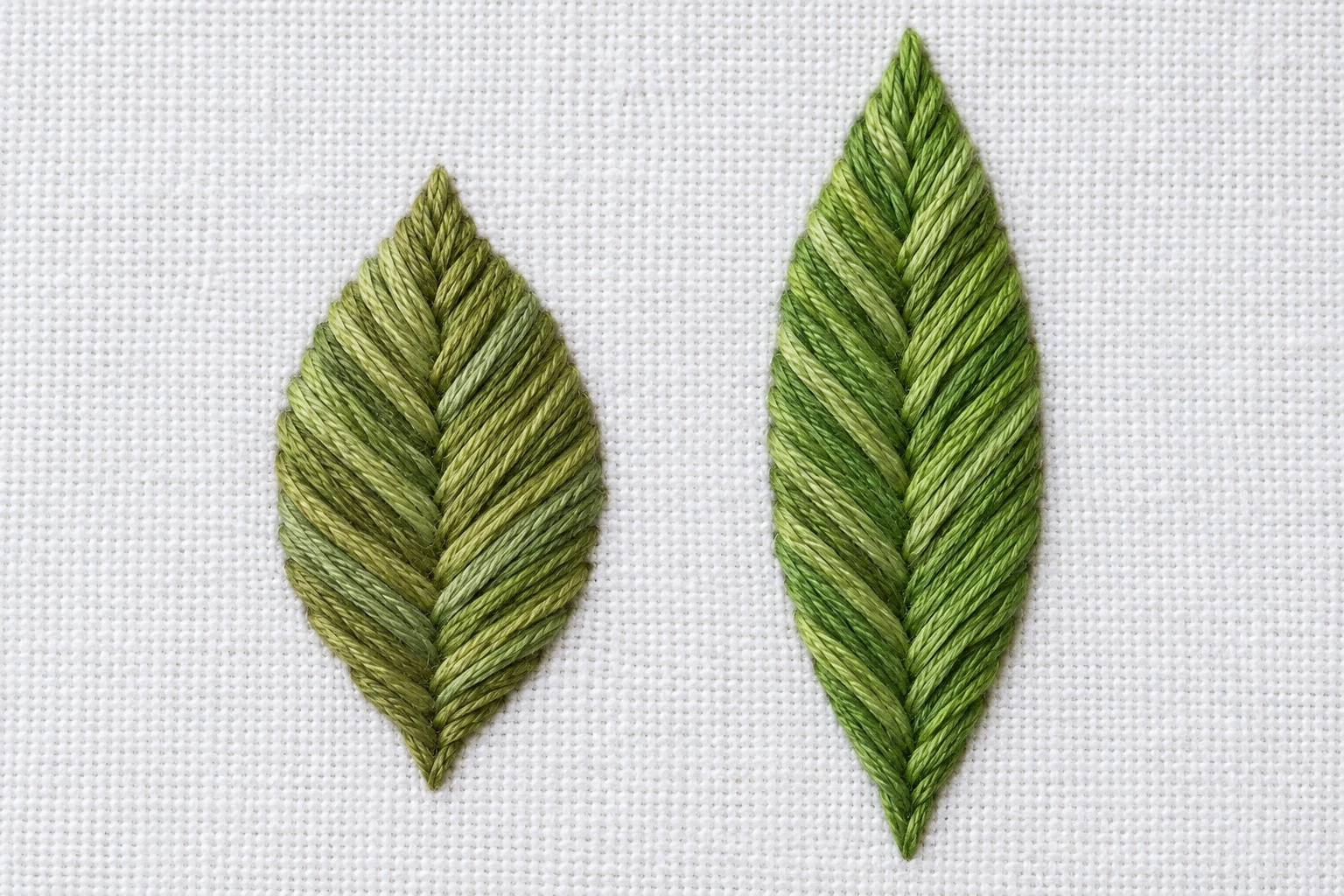
Yes, a stylized feather shape with a clear center can use the same alternating structure. Adjust the outline and stitch direction to the drawing.
Further reading
Adapted from SimpleEnglishGuide.pdf, PDF pages 10. Wording and practical notes have been edited for this website.