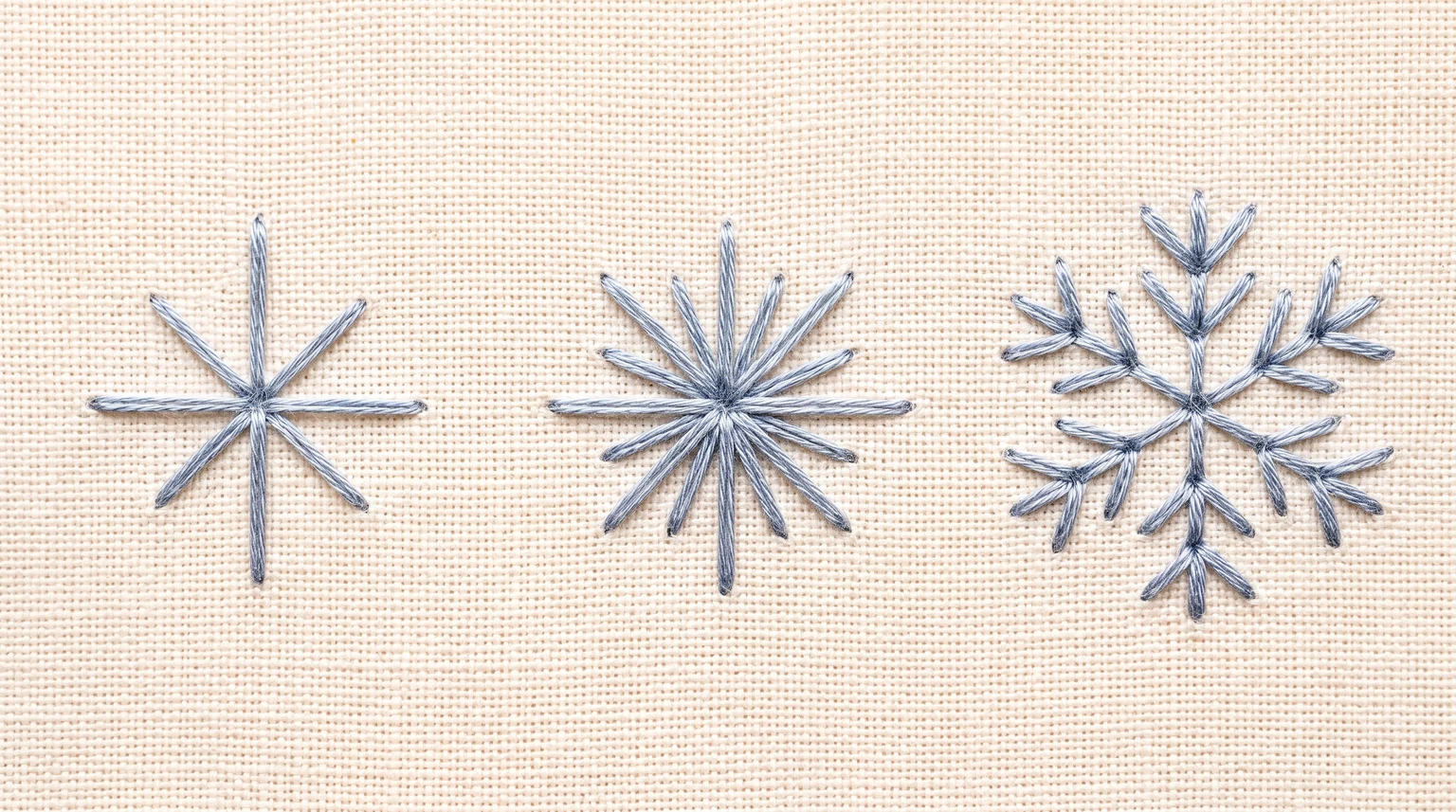
A few crossed straight stitches can suggest a sparkle, star or small snowflake. These details suit open spaces around a motif and can add rhythm without requiring a new complex stitch. The source guide uses them as decorative accents. Keep the scale small enough that the marks support the main design rather than compete with it.
Mark a center and stitch short arms through it. Use a longer vertical and horizontal pair for a simple sparkle, then add shorter diagonals if needed. Keep the shared center from becoming crowded.
Choose the number and length of arms
A four-arm sparkle can be made from two crossing stitches. Adding diagonal strokes makes a fuller star. A stylized snowflake can use three crossing directions, with tiny branching marks when the size allows.
Sketch the complete shape before stitching it. A few clear marks are easier to read than many short branches packed into a very small area. These are decorative interpretations rather than exact drawings of natural crystals.
Stitch a simple crossed detail
- Choose a fine thread bundle suitable for the detail's scale.
- Make the longest straight stitch across the center.
- Add a crossing stitch in the second direction.
- Place shorter diagonal arms if the drawing needs them.
- Check that the surface remains flat and the center is not a bulky knot of thread.
- Secure the thread before moving to a distant detail.
Leave small fabric gaps between closely spaced accents. Long travel threads can show behind pale cloth, so do not carry dark floss across a large blank area unnecessarily.
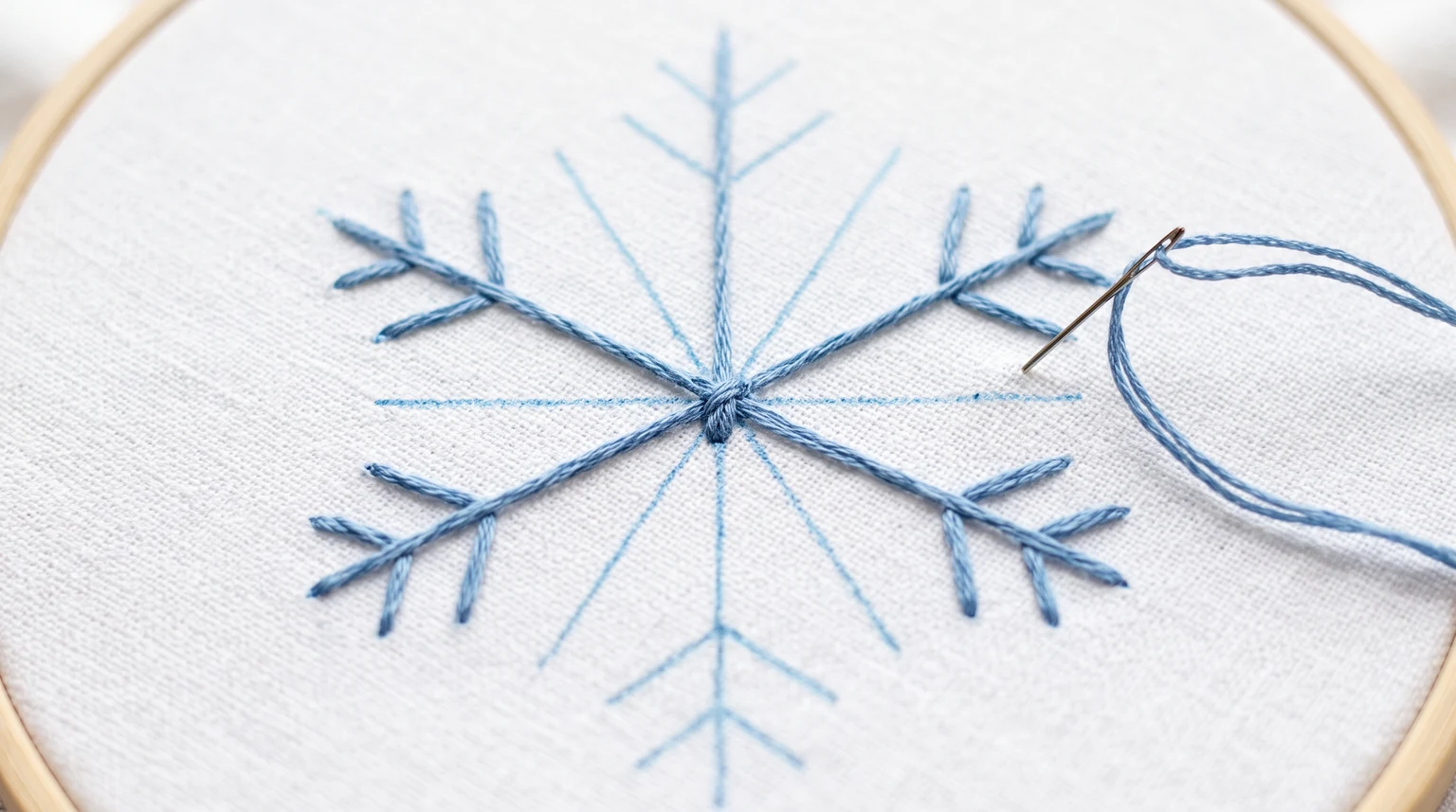
Place details around the main motif
Vary the size of a few accents and leave some blank fabric between them. Avoid putting a sparkle beside every petal or leaf, which can make the drawing busy.
Try a small group around a rose or in a seasonal border. Use ordinary straight stitch practice to control the arm lengths before adding details to a finished design.

Frequently asked questions
How many stitches make a sparkle?
Two crossing stitches can make a four-arm sparkle. Additional shorter strokes create a fuller shape if there is enough space.
Why does the center look bulky?
Too many strands or repeated crossings can build a lump. Use a finer bundle, fewer arms or a slightly larger motif.
Further reading
Adapted from SimpleEnglishGuide.pdf, PDF pages 7, 8. Wording and practical notes have been edited for this website.