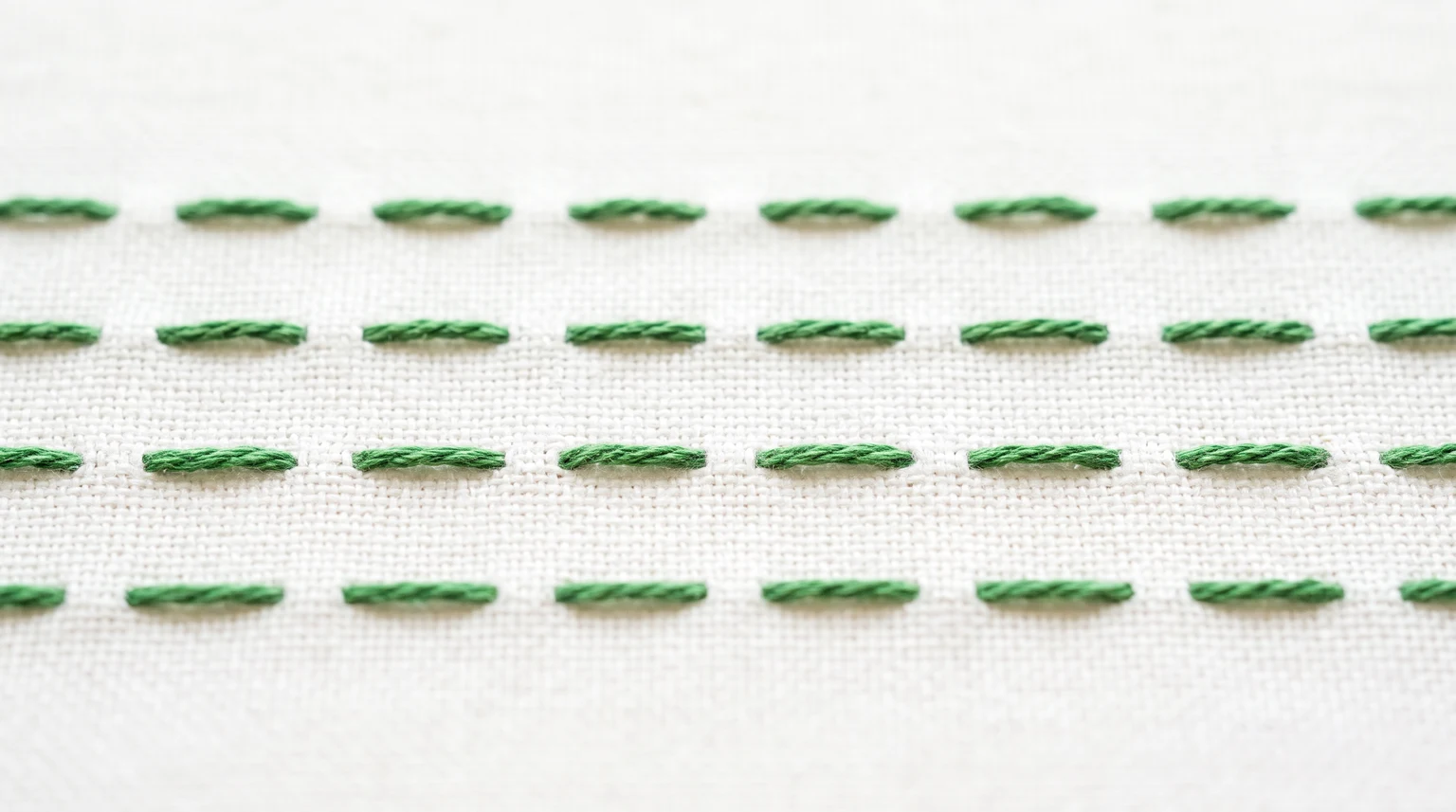
Running stitch is a line of small stitches made by taking the needle in and out along a path. Gaps remain between the visible marks. It can create a decorative dashed outline, temporarily hold layers or gather fabric behind a finished hoop. These uses share the basic movement but need different thread tension.
Bring the needle up, go down a short distance ahead and come up again after a gap. Repeat along the line. Leave the thread relaxed for a flat outline, or pull it gently when the purpose is to gather the fabric.
Prepare a simple practice line
Draw a straight line on stable fabric and choose a manageable thread bundle. Start with one stitch at a time so you can judge its length and the gap.
A dashed border looks regular when both the visible marks and their spaces are consistent. Smaller stitches can follow a curved shape more smoothly than long ones.
Make running stitch
- Secure the thread at the starting point.
- Bring the needle up on the line.
- Take it down a short distance ahead to make a visible stitch.
- Come up after a small gap.
- Continue along the drawing, keeping the cloth flat.
- Secure the thread when the line is complete.
With practice, several stitches can be loaded onto the needle before drawing it through. Begin slowly and keep the weave from bunching up accidentally.
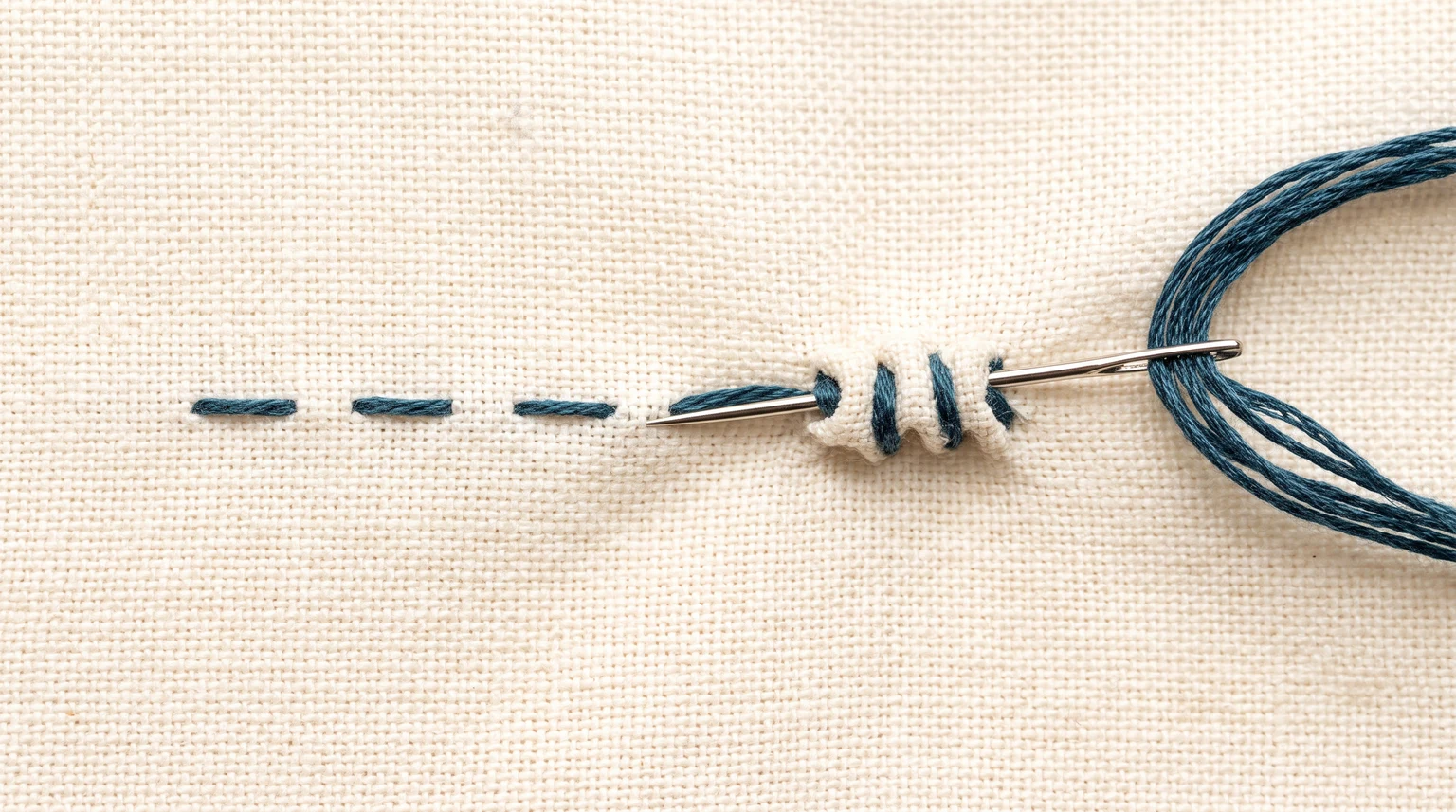
Use running stitch to gather a hoop back
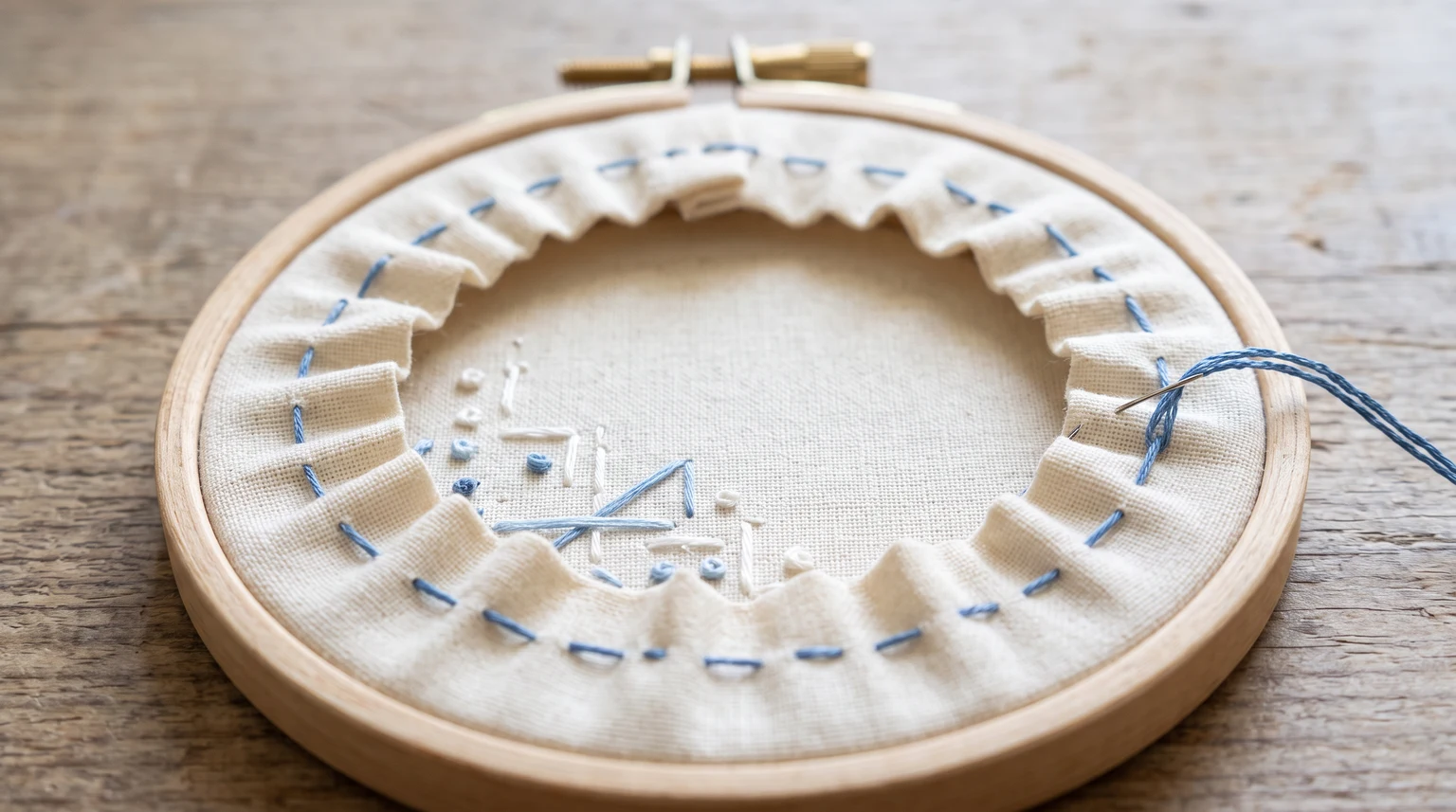
For a hoop finish, work a running stitch around the excess fabric left outside the ring. Use thread strong enough for the task and leave a margin suited to the chosen finish.
Pull gently so the cloth gathers inward, spread the folds evenly and secure the thread. This is a deliberate change in the fabric's shape, unlike a flat embroidered outline. The finishing guide explains how gathering fits with an optional backing.
Frequently asked questions
Is running stitch the same as backstitch?
No. Running stitch leaves gaps between visible marks. Backstitch returns to the preceding endpoint to make a connected line.
Why is the fabric gathering when I only want a line?
The working thread is being pulled too tightly. Ease the tension so each stitch rests on the cloth without shortening the line.
Further reading
Adapted from SimpleEnglishGuide.pdf, PDF pages 20, 22. Wording and practical notes have been edited for this website.