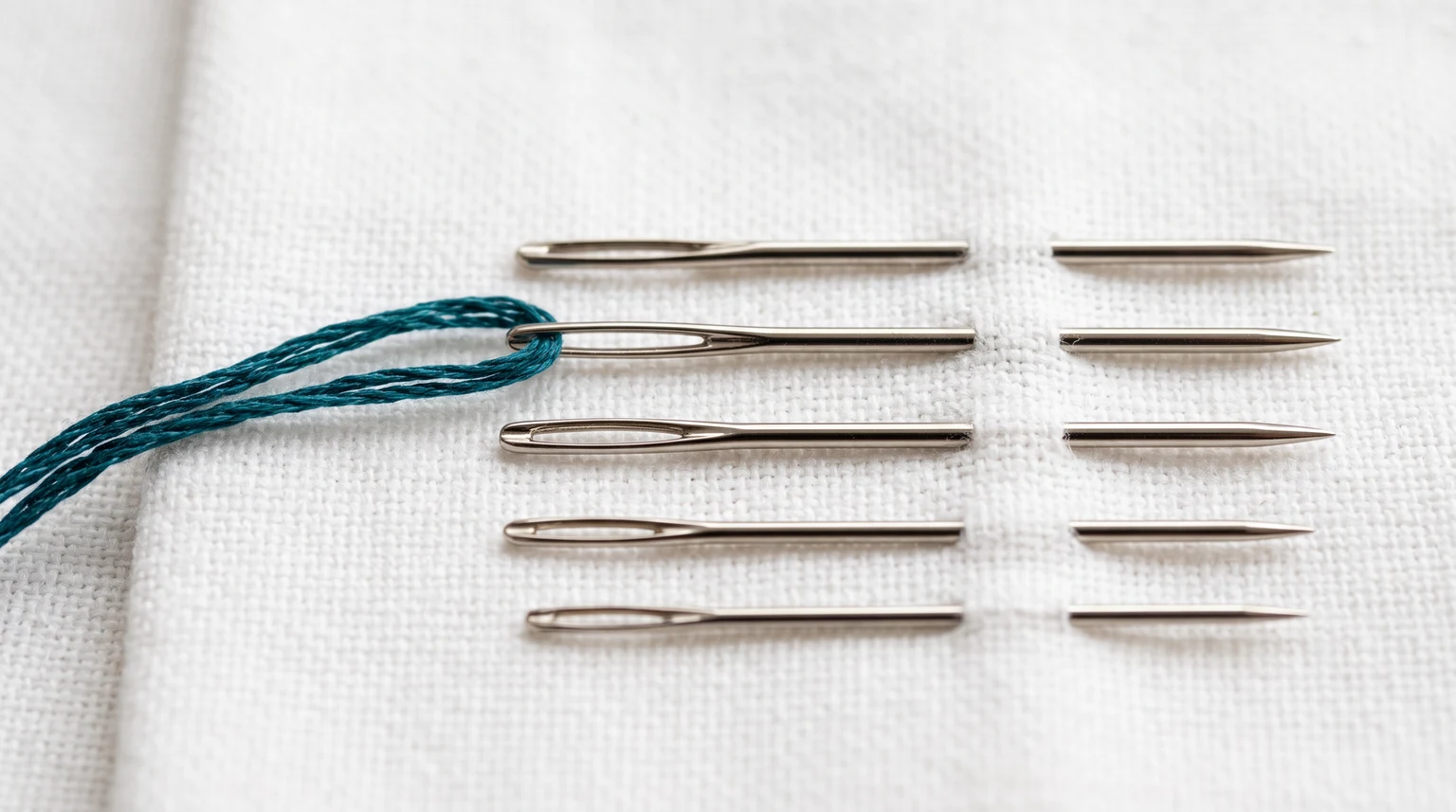
An embroidery needle must carry your thread through fabric without shredding the floss or leaving an oversized hole. The right choice depends on the material, the number of strands and the stitch. For most surface embroidery on ordinary woven cotton, start with a sharp embroidery needle, sometimes called a crewel needle, rather than a blunt tapestry needle.
Choose a sharp embroidery needle with an eye that accepts your selected floss comfortably. Its shaft should open a passage for the thread without visibly damaging the fabric. Test a few stitches on a scrap before committing to the project.
Understand the main needle types
| Type | Point and eye | Useful for |
|---|---|---|
| Embroidery or crewel | Sharp point, elongated eye | Surface stitches on woven fabric |
| Tapestry | Blunt point, large eye | Counted work through existing fabric holes |
| Chenille | Sharp point, large eye | Thicker threads and some ribbon work |
| Milliner or straw | Long shaft with relatively even thickness | Wrapped stitches when the eye must pass through wraps |
A blunt needle can be useful while weaving a raised rose because it is less likely to split the supporting threads. Make the foundation stitches with a sharp needle first. See the rose embroidery tutorial for the difference between piercing the fabric and weaving above it.

Match needle size to floss and fabric
Within many hand-needle ranges, a higher number means a finer needle. Size systems differ across needle types and brands, so compare needles from the same range and check the packet. A mixed pack of embroidery needles is useful because you can try several sizes without guessing from a chart alone.
Thread the number of embroidery floss strands you intend to use. If they bunch tightly at the eye or fray after a few passes, try an eye with more room. If holes remain visible around completed stitches, try a finer needle or a more suitable fabric. Thick thread needs enough passage through the cloth, even when it fits through the eye.
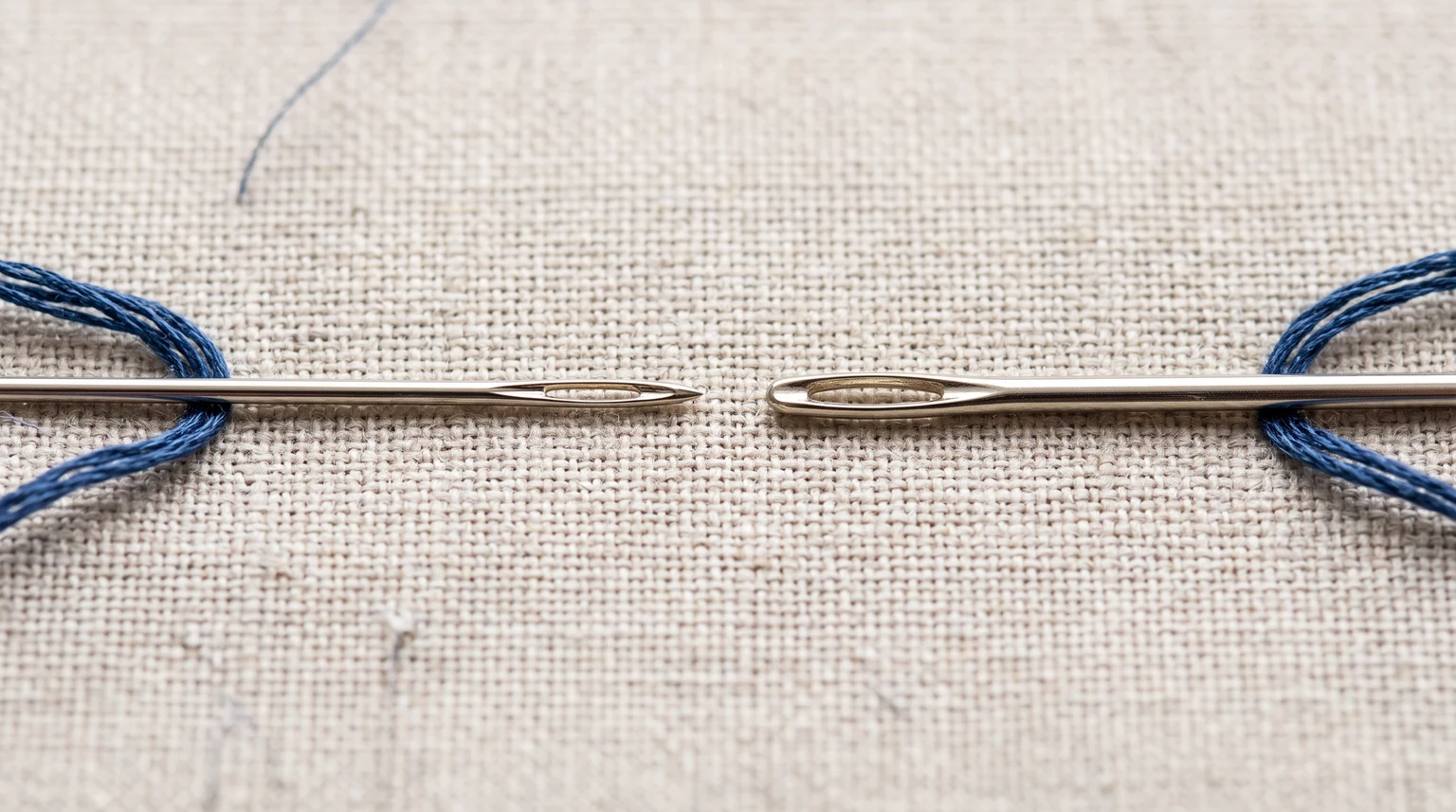
How to thread an embroidery needle
- Cut a manageable length of floss, roughly forearm length as a starting point.
- Separate the required strands individually, then bring them together again. This helps prevent an uneven bundle at the eye.
- Trim the ends evenly with sharp scissors and flatten them between your fingers.
- Hold the thread close to its tip and move the needle eye onto the thread. This keeps the loose end from bending away.
- Pull a short tail through the eye. Keep the working thread single unless the pattern calls for a doubled thread.
A needle threader can help, but do not pull a thick bundle through a fine eye by force. Choose a suitable needle instead. Use good light and a contrasting surface behind the eye to make the opening easier to see.
Diagnose common needle problems
Thread keeps breaking: inspect the eye for a rough edge, check whether the thread is too thick and shorten the working length. Repeated passes through dense stitching can abrade cotton floss even with a good needle.
Needle is hard to pull through: check the combination of needle thickness, strand count and fabric density. A larger shaft can open room for thick thread, while a smaller needle may suit delicate cloth. Do not solve every resistance problem by pulling harder.
French knots jam on the eye: the wraps may be too tight or the eye too bulky for the wrapped stitch. Practise with fewer wraps and consider a needle with a more even shaft. Follow the tension steps in the French knot guide.
Store needles between projects
Keep needles dry in a labeled packet, needle book or closed case so you can find the correct type again. Replace a bent needle or one with visible rust or a damaged eye. Count and put away loose needles before clearing your work surface.
For a first sampler, choose one needle that works comfortably with two strands, then test a line of backstitch before moving to filled shapes. The needle should pass through predictably without pulling the fabric out of the hoop.
Frequently asked questions
Can I use an ordinary sewing needle for embroidery?
For a little fine-thread work, yes. An embroidery needle's elongated eye is usually easier when using several strands of floss.
Should I use a sharp or blunt embroidery needle?
Use a sharp point for surface embroidery that pierces woven fabric. A blunt tapestry needle suits counted work through open holes or weaving above the fabric.
Do I need to double the thread?
Usually no for surface embroidery. Thread your chosen strands through the eye and leave a short tail; doubling changes the effective strand count.