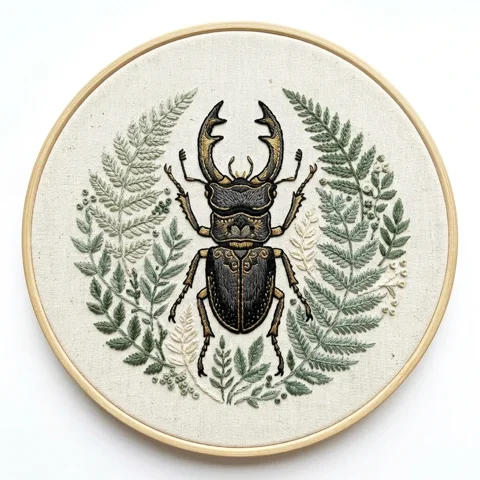
About this Botanical Stag Beetle embroidery pattern
Botanical Stag Beetle brings botanical and woodland details into a hand-embroidery composition. Study the colored design and outline together before choosing which shapes to shade, outline or simplify. The supplied guide identifies these motifs: small fern fronds, leafy stems, dots, and seed-like knots. Long dark wing cases angle downward over a rounded abdomen, while two translucent cream wings stretch horizontally behind them. Fern branches and clusters of tiny berries frame the upper body, creating a balanced woodland specimen look. The palette stays muted and natural, with moss, olive, forest green, black-brown, tan, and soft ivory. Recommended DMC Color Palette Treat this palette as a practical map. Keep the beetle’s outer contours dark and crisp, then layer several greens inside so the shell and botanical decoration remain readable rather than merging into one flat tone. DMC Color Suggested use 310 Black Deepest outlines, leg tips, narrow separations, and the darkest mandible edges. 3371 Black Brown Main contour alternative, body shadows, joints, and wing-case borders. 934 Avocado Green Black Dark shell sections, lower wing cases, thorax depth, and shadowed foliage. 935 Avocado Green Dark Primary beetle shell fill, fern motifs, and dark botanical sprays. 936 Avocado Green Very Dark Transitions between black-brown outlines and mid-green fills. 937 Avocado Green Medium Leaf veins, body highlights, fern needles, and middle-value texture. 3011 Khaki Green Dark Muted foliage, botanical motifs on the shell, and shaded seed clusters. 3012 Khaki Green Medium Fern branches, thorax ornament, pale green shell details, and soft transitions. 3013 Khaki Green Light Fine leaf highlights, small decorative lines, and selected raised dots. 3052 Green Gray Medium Cool sage highlights across the head plates and upper thorax. 3053 Green Gray Light botanical fill, subtle wing-case motifs, and soft fern tips. 3781 Mocha Brown Dark Warm mandible shading, body bands, leg joints, and earthy accents. 420 Hazelnut Brown Dark Mid-brown highlights on mandibles, abdomen bands, and leg segments. 613 Drab Brown Very Light Pale wing veins, warm highlights, and restrained shell accents. 3866 Mocha Brown Ultra Very Light Translucent wing fill, soft ivory highlights, and the palest vein details. Stitch Plan by Design Area Mandibles Outline with split stitch in 3371 or 310. Fill with short-and-long stitch following each curve, blending 934, 935, 3781, and 420. Add narrow 613 highlights along selected inner ridges. Head and thorax plates Use padded satin stitch or close long-and-short stitch in 935, 937, 3011, and 3052. Work each plate separately so the segmented anatomy stays clear. Botanical Stag Beetle in Forest Ferns Page 3 Wing cases Build a dark 934/935 base with long-and-short stitch. Add fern shapes using fishbone stitch, fly stitch, and tiny straight stitches in 937, 3012, and 3053. Exposed wings Keep them light with one-strand back stitch for the veins and sparse long-and-short stitches in 3866 and 613. Leave some fabric visible to preserve a translucent effect. Abdomen Use curved satin or long-and-short stitch in 934, 935, and 3781. Overlay the central leafy sprig with stem stitch and fishbone stitch in 3011–3013. Legs Work narrow stem stitch or tightly spaced split stitch in 3371 and 310. Add tiny 420 highlights on the thicker upper joints. Fern branches Use stem stitch for each main branch, then add paired straight stitches or fine fishbone stitches in 935, 937, 3011, and 3012. Seed dots and berries Use French knots or colonial knots in 3012, 3013, 613, and occasional 420. Vary wrap count slightly to keep the clusters organic. Thread Count & Blending Guide Application Strands Recommendation Fine outlines and wing veins 1 Use one strand of 310, 3371, or 613 for clean anatomy and delicate transparent-wing lines. Main shell fills 2 Two strands give enough coverage while preserving the small fern and leaf details. Botanical motifs 1–2 Use one strand for tiny fronds and two for broader fishbone leaves. Raised dots 2–3 Two strands for small seed knots; three only for a few foreground accents. Blend: 1 strand 935 + 1 strand 937 2 total Natural dark-to-medium green transitions across the wing cases. Blend: 1 strand 3011 + 1 strand 3012 2 total Muted khaki foliage and softly shaded shell ornament. Blend: 1 strand 934 + 1 strand 3371 2 total Rich, nearly black green for the deepest shell shadows. Blend: 1 strand 3866 + 1 strand 613 2 total Warm translucent cream for the pale wings and highlighted veins. Outlining, Shading & Texture Suggestions Outline selectively Use the darkest line around the outside silhouette, mandible cutouts, wing-case edges, and leg joints. Keep internal botanical lines softer in green or brown. Shade by segment Treat every body plate as a separate rounded form: darkest at the edge, medium in the center, and a narrow sage or tan highlight toward the light-facing ridge. Botanical Stag Beetle in Forest Ferns Page 4 Layer shell decoration Complete the dark shell base first. Add ferns, leaves, and dots afterward so they sit visibly on top instead of disappearing into the fill. Keep wings airy Avoid solid satin fill on the pale side wings. Sparse one-strand stitches, open fabric, and fine veins create a more convincing translucent texture. Vary leaf direction Angle fishbone and straight stitches along each leaf’s natural center line. This makes the botanical pattern look grown into the beetle rather than stamped onto it. Reserve the lightest values Use 3866 and 3013 sparingly on wing veins, shell ridges, fern tips, and a few knots. Small highlights give more depth than broad pale areas. Beginner-Friendly Practical Tips Transfer in sections Trace the outer beetle, large body divisions, wings, and major fern stems first. Add the smallest internal leaves and dots only after the main shapes are secure. Use a stable fabric This design has dense thread coverage. A firm linen or cotton-linen blend helps prevent puckering; lightweight cotton may benefit from a removable stabilizer. Short thread lengths Work with about 14–16 inches of floss. Dark greens and browns show fuzz quickly, and shorter lengths keep the shell stitches smoother. Check symmetry often Alternate between the left and right sides. Matching the mandibles, wings, and large fern branches gradually is easier than finishing one side completely first. Do not overpack stitches Dense areas need coverage, not excessive layers. Place stitches closely but avoid forcing the needle through already crowded holes. Photograph progress A quick phone photo makes uneven values easier to spot. Deepen one shadow or add one highlight rather than restitching an entire section. Quick Working Recipe 1 Transfer the outer beetle silhouette, body divisions, wings, legs, and surrounding fern stems onto the fabric. 2 Work the pale side wings first using one-strand veins and sparse cream shading, keeping plenty of fabric visible. 3 Outline the mandibles, head, thorax, wing cases, abdomen, and legs with split stitch in 3371 or 310. 4 Fill the mandibles and body segments from dark to light, following the curve of each anatomical section. 5 Complete the wing cases with layered dark greens, then stitch the fern and leaf motifs over the finished base. 6 Add the abdomen’s central botanical sprig and the smaller patterned details on the head and thorax. 7 Stitch the surrounding fern branches and berry stems, balancing the left and right sides as you go. 8 Finish with French knots, pale highlights, leg-tip details, and any final dark contour corrections. 9 Remove visible transfer marks, gently press from the back on a padded towel, and re-hoop the finished needlework evenly.
The colored image is a design reference. Thread, fabric and your stitch choices will affect the finished result. Preserve the open spaces around the smaller motifs and test difficult fills on a spare piece of fabric before stitching the main design.
Printable outline preview
This watermarked preview shows the transfer drawing. Clean outlines are included in the purchased pattern PDF.
Choose your hoop size
The outline pages are labeled for 3, 4, 5, 6, 7, 8 inch hoops. Measure the printed design before transfer, because printer margins and fit-to-page settings can affect its dimensions.
A larger version gives fine contours and clustered motifs more room. Select the size that preserves the details you want to stitch.
Color and stitch guidance
The supplied PDF contains the design's DMC color suggestions and stitching guidance. Compare important shades with real floss under your working light.
The supplied guide labels this design intermediate. Allow time for controlled spacing and detailed areas.
Stitching sequence
- Choose an outline size for Botanical Stag Beetle, print it and measure the result before transferring the drawing to taut fabric.
- Consult the supplied DMC and stitching guide before starting. Work structural outlines and larger shapes before small overlapping details.
- Follow the design reference for spacing and the guide for stitch direction. Keep thread tension even and check that dense areas do not pull the ground fabric.
- Finish fine accents, secure thread ends and remove transfer marks according to the marking product's instructions.
Review the full guide in your download for motif-specific thread placement. General techniques are covered in pattern transfer methods and finishing an embroidery hoop.
What your download contains
Your purchase opens a private Google Drive folder containing the three listed PDFs. The clean outline is inside the main pattern PDF. The gridded image reference is separate from the surface-embroidery drawing and is not a machine embroidery file or a symbol-by-symbol DMC cross-stitch key.
Download access appears after payment is confirmed, with recovery available through the purchase email. See the delivery policy for access and support details.
Pattern questions
Is this for hand embroidery?
Yes. The outline and stitching guide are for hand embroidery. No machine-ready PES or DST file is included.
Will I receive a physical kit?
No. This is a digital pattern package. Hoops, needles, thread, fabric and a finished piece are not included.
Can I sell a finished embroidery piece?
You may sell small quantities of physical pieces stitched by you under the pattern license. You may not resell or share the digital pattern files.
What if I cannot open or download the files?
Use order recovery or contact support with your order reference. Damaged files, duplicate purchases and delivery problems are covered in the refund policy.
More botanical patterns