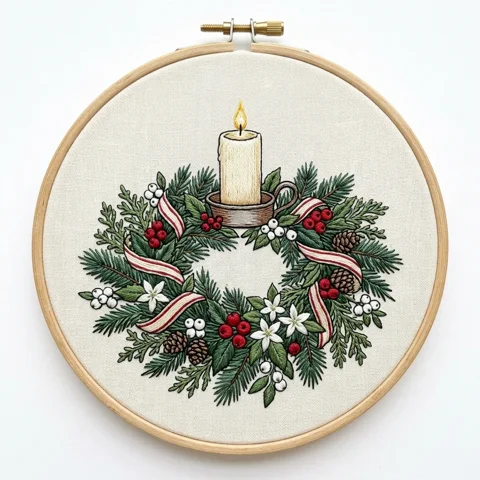
About this Mint Botanical Candy Cane embroidery pattern
Mint Botanical Candy Cane brings christmas and winter details into a hand-embroidery composition. Study the colored design and outline together before choosing which shapes to shade, outline or simplify. The supplied guide identifies these motifs: red-and-ivory hooked candy cane, pale mint leaves, muted sage and olive leaf sprays, soft rose buds, red berries, warm-gold seed dots and interlacing dark green stems.
The colored image is a design reference. Thread, fabric and your stitch choices will affect the finished result. Preserve the open spaces around the smaller motifs and test difficult fills on a spare piece of fabric before stitching the main design.
Printable outline preview
This watermarked preview shows the transfer drawing. Clean outlines are included in the purchased pattern PDF.
Choose your hoop size
The outline pages are labeled for 3, 4, 5, 6, 7, 8 inch hoops. Measure the printed design before transfer, because printer margins and fit-to-page settings can affect its dimensions.
A larger version gives fine contours and clustered motifs more room. Select the size that preserves the details you want to stitch.
Color and stitch guidance
The supplied guide proposes 18 DMC colors. Compare important shades with real floss under your working light.
The supplied guide labels this design intermediate. Allow time for controlled spacing and detailed areas.
warm ivory linen, 8 in / 20 cm hoop, with stable even tension for crisp striped fills and delicate stems
Stitching sequence
- Transfer and registration Trace the hooked candy cane, curved red stripe boundaries, diagonal leafy sprays, small flower buds, red berries and loose gold dots. Identify overlaps where branches cross the cane.
- Ivory then red cane bands Lay smooth 3865/Ecru satin fills following the curve of the cane. Stitch 321 red bands with long-and-short shading in 498 and 3712. Avoid flat horizontal bands on the rounded hook.
- Cane contour and depth Define outer edges and band boundaries in one-strand 498 or 816 split/backstitch. Keep ivory/red transitions crisp and deepen only select recesses.
- Sage and mint foliage Work medium-to-large leaves in 3813/928/927/926 fishbone stitch, following each central vein. Layer 3052/3053 on olive leaves; retain ivory gaps between foliage clusters.
- Fine stems, berries and buds Stitch the crossed stems with 3051/924 stem stitch. Add berry knots in 321/498, small flower petals in 3727/3712 and scattered gold French knots in 729.
- Refine and block Clean up leaf contours, vein placements and crossings; keep the cane visually dominant. Remove guide marks and block with light tension to protect raised berries
Review the full guide in your download for motif-specific thread placement. General techniques are covered in pattern transfer methods and finishing an embroidery hoop.
What your download contains
Your purchase opens a private Google Drive folder containing the three listed PDFs. The clean outline is inside the main pattern PDF. The gridded image reference is separate from the surface-embroidery drawing and is not a machine embroidery file or a symbol-by-symbol DMC cross-stitch key.
Download access appears after payment is confirmed, with recovery available through the purchase email. See the delivery policy for access and support details.
Pattern questions
Is this for hand embroidery?
Yes. The outline and stitching guide are for hand embroidery. No machine-ready PES or DST file is included.
Will I receive a physical kit?
No. This is a digital pattern package. Hoops, needles, thread, fabric and a finished piece are not included.
Can I sell a finished embroidery piece?
You may sell small quantities of physical pieces stitched by you under the pattern license. You may not resell or share the digital pattern files.
What if I cannot open or download the files?
Use order recovery or contact support with your order reference. Damaged files, duplicate purchases and delivery problems are covered in the refund policy.
More christmas patterns